Mold After Water Damage: The 24–48 Hour Rule
Ask any restoration professional what decides whether a water loss stays simple, and you will hear the same number: 24 to 48 hours. This guide explains what that window really means — and what to do inside it.
Why 24–48 hours?
Mold spores are already everywhere — in every home, all the time, harmless in normal numbers. What they need to become a colony is moisture on a food source, and a wet home offers both: drywall paper, wood framing, carpet backing and dust are all food. On materials that stay wet, germination can begin within 24 hours and visible growth follows within days. The window is not a scare tactic; it is the biology of the organism, and it is why every legitimate water-damage process is built around drying speed.
The corollary matters just as much: materials dried below the moisture threshold inside that window generally do not grow mold at all. Fast, verified drying is not one prevention strategy among many — it is the strategy.
Where mold hides after water damage
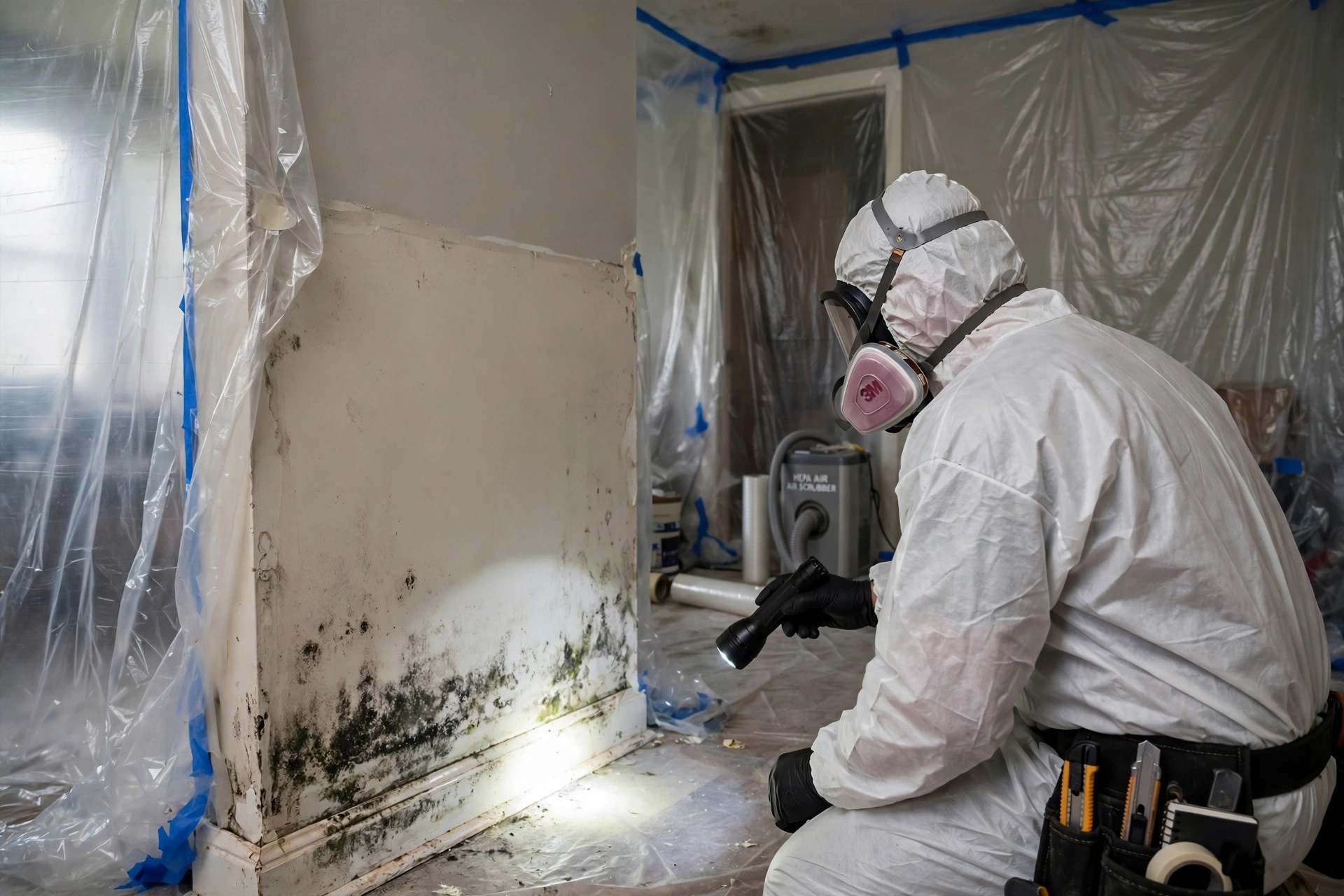
The growth you can see is rarely the whole colony. After a leak, mold favors the places that dry last and are checked least: the back side of drywall inside wall cavities, under flooring and inside the padding layer, inside HVAC ducts and air handlers that ran while wet, behind baseboards, and in basement rim joists and insulation. A musty smell with no visible growth almost always means one of these reservoirs exists.
This is why 'we dried it with fans' so often fails quietly — the surfaces felt dry while the cavities stayed wet for a week.
What actually prevents mold
Extraction within hours, not days. Moisture mapping that includes cavities and under-floor readings, not just surface checks. Drying equipment placed by that map and monitored daily until readings reach dry standards. Removal of materials that cannot dry in place — carpet pad is the most common — instead of hoping they will. And antimicrobial treatment of affected surfaces as a supplement to drying, never a substitute for it.
What does not work: bleach on porous materials (it cannot reach the roots and adds water), paint or sealant over damp drywall, and ozone or fogging treatments used instead of drying and removal.
If the window was missed: reading the situation honestly
Finding this guide on day five does not mean your home needs a five-figure remediation. It means the job now starts with an inspection: how far did moisture travel, is there visible growth, and how large is the affected area? A few square feet on a surface that can be removed cleanly is a small, contained job. Growth inside multiple wall cavities, or in the HVAC system, is a larger one that needs containment and HEPA air control.
Either way, the moisture source must be fixed and the structure verified dry before anything is closed up — remediation without those two steps is a subscription, not a solution. If you are in Ashburn and unsure which situation you have, an inspection settles it: call (703) 555-0147.
The rule, restated
Water damage is a clock, not just a mess. Inside 24–48 hours, drying wins and mold never starts. Outside it, inspection and honest scoping keep a small problem small. The worst option at any point on that timeline is the same: waiting to see. Water never improves a home by being left alone in it.
Frequently asked questions
Does mold always grow after water damage?
No. Clean water extracted quickly and dried to verified levels within the first day or two usually results in no growth at all. Mold follows moisture that lingers — which is a process failure, not an inevitability.
I can smell mustiness but see nothing. Is that mold?
Very likely a hidden reservoir — inside a wall, under flooring or in the HVAC. The smell is the detection system working; the inspection finds the source. Do not let anyone quote remediation for it sight unseen, and do not ignore it either.
Is black mold an emergency?
Any indoor mold growth should be removed properly, and large areas or HVAC involvement deserve prompt professional handling. Panic is not required; delay is not advised. People with asthma or immune concerns should stay out of the affected area until it is remediated.
Will my insurance pay for mold remediation?
Often only when the mold follows a covered water event, and many policies cap mold coverage. Documentation that ties growth to a specific, dated water event — photos and readings from the first visit — is what gives the claim its chance.
Water damage gets worse by the hour
One call starts the process. A restoration coordinator will explain the next steps, answer questions about cost and insurance, and dispatch a crew anywhere in Ashburn, day or night.
Call (703) 555-0147 — 24/7